We have studied the concept of Advaita and the Bliss that results from the experience of Advaita in our blog http://advaitananda-mohan.blogspot.com/
Readers are requested to refer to blog Advaitananda for the concepts underlying our study.

Friday, August 26, 2011

HOW WORK IS PERFORMED

UPADESHA SARAM
SLOKA 4
HOW KARMA IS PERFORMED
Kaaya Vangmanaha Karyamuththamam
Poojanam Japaschinthanam Kramath
Kaaya – the body
Vak –speech, language, talk, words
Manaha ( manas) – mind
Karya – what ought to be done, performed
Uthamam – best, excellent, foremost, highest
Poojanam – worshipping, adoring
Japa – repeating or muttering prayers in an undertone, repeating passages of the Veda or names of deities
Chintanam – thinking
Kramath – gradually, in step by step, progressively
The best action (or work) is performed by the body, the power of speech and the mind (respectively) to carry out worship (of a deity) and( then) to repeat prayers ( or incantations) and (further) to meditate in a step by step ( and progressive) manner.

THE NATURE OF WORK OR KARMA
Indian philosophy considers work (karma) from several angles. It is interesting to look at these viewpoints so we develop deeper insights into the wealth of meaning enclosed in Bhagavan’s apparently simple statements.
• KARMA FROM THE VEDIC VIEWPOINT.

As we have discussed already, the Vedas comprise basically two sections, the Karma Kanda and the Jnana Kanda. The Karma Kanda looks at work or karma primarily from a duty viewpoint.
Action or Work in human life is considered to be of two types: loukika
and aloukika.
Loukika work is work performed in the temporal world for material benefits and survival.
Aloukika work is work performed for spiritual benefits. This type of work is itself classified into two types: nithya and naimithika.
Nithya karma is work performed as a routine everyday and mainly comprises sandhya vandanam, simple puja to one’s favorite deity, prayers during bath, prayers before meals and prayers before sleep. This is conditioned by one’s family traditions, the prevailing culture in society, the traditions of a country and the religion to which one belongs. The nithya karma is meant to help a person maintain contact with the Divine Principle.
Naimithika karma is the performance of rituals in accordance with one’s family tradition and one’s religion and generally covers three important components:
-Duty to one’s forefathers, the pitrus;
-Duty to Gods or the Divinity inherent in various aspects of life, the devas;
-Duty to all other living organisms in the environment, bhutas.
Loukika karma is the work that one performs in the course of one’s studies and as part of one’s career. This work is colored with the need for survival, for ensuring material benefits, and involves interacting with the world in many ways.
Every religion has its own interpretation of nithya and naimithika karmas. Many of these practices have fallen into disuse over the centuries because the teachers in the religion have not been able to explain the meaning and utility of these practices. India has been singularly fortunate in continuing the practice of Vedic practices in spite of foreign onslaughts and the infusion of foreign cultural practices. This is because of the existence of the system of Gurukula or the ‘tradition of the teacher’. The teachers are enjoined by the Vedas to preserve, practice, teach, interpret, and inculcate the Vedic practices. The teacher or the Guru is considered as equivalent to the Divine Principle and through such highly educated and accomplished teachers, the system of Vedic practices has remained intact through generations. People were chosen for this duty based on their knowledge, their aptitude, and their insight.
(From time to time through history these positions were taken by less accomplished men or ambitious men or politically inclined persons. During these times the system tended to be misused and misinterpreted. However every time such an eventuality occurred, there was a Divine intervention. Buddha was a rebel who refused to accept the Vedic teachers probably because the system had developed fissures. Sri Sankara was another rebel who questioned the Buddhists whose system had developed inconsistencies. The Purana describes the case of Prince Prahalada who questioned the obduracy and attitude of his own father, Hiranyakashipu. Another important case is of the King Bali who refused to accept the injunction of his Guru, the sage Shukracharya and submitted to the Divine Incarnation, Vamana. When the Vedic practices were on the brink of destruction by King Kamsa, the Divine Principle incarnated as Sri Krishna and re-established the supremacy of the Vedic way of life. Such instances are seen in the case of other religions as well, such as the intervention of Martin Luther when the Christian Catholic Church was beset with corrupt practices.)
• THE KARMA YOGA OF SRI KRISHNA
About 5000 years ago, a new interpretation of the Vedic Karma Kanda was promulgated by Sri Krishna. This is recorded by Sri Veda Vyasa in the famous Bhagavat Gita, the Song of the Lord, where Sri Krishna’s philosophy is set in 700 stanzas. In this treatise, Sri Krishna describes the concept of Karma Yoga. When Sri Krishna uses the term Karma, He covers both the aloukika (spiritual) and loukika (material) forms of work. He cannot be said to be talking only of the spiritual practices.
He essentially differentiates between kamya (desire-driven) and nishkama (desire-less) work.
Kamya karma seeks a result, a reward and a return. Kamya karma is
motivated and driven by desire for something.
Nishkama karma is totally desire-less and driven more by a sense of
duty than desire.

Many Vedic practices can have a clear favorable result envisaged as the objective. Yagnas and Yagas are known to be related to the birth of progeny or the urgent need for rainfall. The Putrakameshti Yaga performed by King Dasharatha was for the clear purpose of progeny. Similarly the Rajasuya Yaga performed by Yudishtara was for the purpose of establishing his right over a territory and to elicit the acceptance of his peers to his supremacy. Another instance of the performance of a complex Vedic Yaga for the explicit purpose of establishing the supremacy of a King is the performance of the Ashwamedha Yaga by Sri Rama when He was challenged by His own sons, Lava and Kusha. There are countless Vedic practices listed and given in detail in the Karma Kanda of the Vedas for clearly result – oriented purposes.
Just as the Roman Catholic Church started focusing on the material aspect of its practices involving money, and the Jewish Temples started demanding the sacrifice of animals at a tremendous cost to the ordinary devotee (that resulted in the denunciation of the practice by Jesus), so can a powerful priestly class learned in the Vedas take advantage of the ordinary devotee.
There are two aspects to the performance of ritual practices, that is, the performer of the ritual (yajamana) and the counselor or adviser (purohita). They are both important for the successful implementation of the ritual. Normally, Vedic tradition advises the performance of a particular ritual in a specific manner for the fulfillment of the purpose of life for the yajamana and his family. Nearly 40 different practices are enjoined on a householder in the course of his life. This advice ensures the fulfillment of the householder’s duties to the three groups, the pitrus, the devas and the bhutas. This ensures the stability of the universe. The role of the purohita is to advise the yajamana on the correct practice in all its aspects. In this pristine form, the ritual is nishkama or desire-less as it only seeks the natural stability of the universe in all its aspects.
However, when the greed for power becomes the motivation as in the case of Kamsa who usurped the throne from his father and wanted to get his accession constitutionally ratified by a Vedic practice, or the case of Hiranyakashipu who wanted to perpetuate his own name as the preferred deity in place of Vishnu, or the case of Ravana who wanted to get Sita’s acceptance of his overlordship, then the same Vedic practice becomes malafide and kamya.
Similarly, if the adviser or counselor becomes greedy and wants to make money out of the performance of a ritual by an ignorant devotee who is fearful of the consequences of failure to do so, then the ritual becomes kamya.
In focusing on the question of kama (desire) and nishkama (desirelessness), Sri Krishna brings up the question of ‘motive’ in the Bhagavat Gita.
The performance of Vedic practices is important for the stability, the balance and the prosperity of the world and the universe. That is the raison d’être for the householder who earns and spends for the benefit of his family and the world at large. The grihastha (householder) is the bulwark for the maintenance of the purohita class and for their upkeep and their continued knowledge and performance of Vedic practices. Both have to work selflessly without a tinge of greed or personal aggrandizement. Such nishkama work is enjoined and upheld by Sri Krishna as the most important duty of both.
Both performers use their body, their speech and their mind to ensure that the Vedic practice is performed in the right manner.
Indeed the same conditions apply to aloukika or materialistic work too. Every action has to be considered as a duty to be performed selflessly. This is the message of Sri Krishna, Bhagavan Sri Ramana and indeed Sri Sathya Sai Baba.

• THE ROLE OF THE BODY, SPEECH AND THE MIND
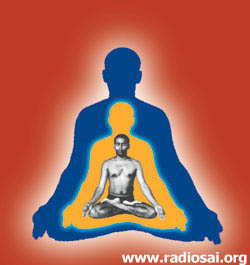

The ancient analysis of the human body is to define his body in terms of ORGANS OF PERCEPTION (Jnanendriyas) and ORGANS OF ACTION (Karmendriyas). Both are five in number, that is, there are five organs of perception and five organs of action.
PERCEPTION ACTION
1 Ears ( sound) Hands (to write, eat, hold,work)
2 Eyes (form, light) Legs ( to stand,walk, lift, push)
3 Mouth (taste) Mouth (to eat, drink, speak)
4 Nose (smell) Genitals (to urinate, reproduction)
5 Skin (touch) Anus ( to excrete)

Each of the organs of perception are designed to identify, be sensitive to and experience a specific aspect of the manifest universe.
These characteristics of the manifest universe are called TANMATRAS or VISHAYAS. Each specific characteristic is present in nature because of a specific component. The manifest universe is said to be a combination of five basic elements or building blocks called the PANCHA MAHABHUTAS. The material universe is a wonderful and multifaceted set of permutations and combinations in all sorts of myriad ways of the Pancha Mahabhutas.
Each Mahabhuta is distinctly characterised by a specific Tanmatra or Vishaya. Also the Pancha Mahabhutas are themselves evolved from each other in a specific way and are thus closely interrelated.
This declension and derivation is as follows:
Pancha Mahabhuta Derived as Tanmatra/Vishaya
1 Akasha (Basic Space) Akasha Sound
2 Vayu ( Basic Air-Gas-Vapour) 1/2 Akasha +1/2 Vayu Touch
3 Teja (Basic Energy,Heat,Light) 1/2 Vayu + 1/2 Teja Sight, Form , Light
4 Jala( Basic Liquid) 1/2 Teja +1/2 Jala Taste
5 Prithvi (Basic Solid ) 1/2 Jala + 1/2 Prithvi Smell
Thus solid manifestation incorporates all the Mahabhutas in differing degrees. All solids display smell, taste, form( or color), texture(or touch) and sound (or vibration).
The liquid manifestation incorporates all except the Prithvi or solid Tattva ( or Principle). Hence all liquids display taste, form (or color), touch ( or feel) and sound (or vibration).
The energy manifestation incorporates only three Mahabhutas, that is, light ( or color), touch( or feel) and sound( or vibration).
The air manifestation incorporates touch ( or feel) and sound ( or vibration).
The basic space manifestation is pure space and carries only vibrations of sound.
Most of the material world that we experience in our day to day life comprises the Prithvi Tattva and hence almost everything we experience gives us all sensory experiences like smell,taste, color, or light(form), touch and sound.
Pure distilled water may come closest to the Basic Jala Tattva and not have smell. Pure light or heat may come close to the Basic Teja Tattva and not have smell or taste. Pure air, as met with at very high altitudes will have only touch.
All aspects of the manifest world have the Akasha Tattva and hence conduct sound vibrations. Thus sound is considered a means of interpenetrating the whole of manifest creation. This gives a clue to the importance given to sound in the Vedas and the Mantras contained therein.
The human being, like many other forms of creation, is thus endowed with the inherent power to produce sound. The sound issues forth from the mouth and is conditioned by his vocal chords, the movement of his tongue, the movement and position of his lips and the volume of air he pushes out from his throat.
Man can perform a variety of actions with various parts of his body. In addition, he is capable of producing a variety of sounds from his mouth. The mouth is both an organ of perception (taste) and an organ of action (sound). The Sanskrit word for the voice of man is VAK.
The five organs of perception and the five organs of action work closely together to help man live his life. Thus with the organs of perception taking in stimuli and the organs of action giving out stimuli, man coordinates his life.
This coordination of perception and action, the eye and the hand, the ear and the voice, the taste and the hands, and so on takes place through the power of MIND.
The whole body, with its ten organs, acts through instantaneous messages through myriad nerves connected to the brain. The brain in turn is activated by the mind.

• THE MIND
MIND is a complex concept. There are many facets and generally, when one uses the word ‘Mind’ one means a composite of all these facets. What are these facets?
The first facet of Mind is THOUGHTS. Mind is described as continually thinking thoughts. Thoughts of one kind or another are continually streaming through the Mind. Ancient scriptures compare the stream of thoughts to an unending flow of oil.
Thoughts have ‘content’ and ‘feeling’. Content (or matter or facts or data) is like the texture of a material. Feeling (or emotions) is like the color. Every thought is inextricably associated with a feeling.

The next facet of the Mind is MEMORY. Memory is stored thoughts, and like all thoughts, it has content and feeling. This stored memory could be from experiences of this lifetime or it could also include experiences of previous lives. Memory can enter the thought stream in the waking condition. One can recall memories consciously when awake. Memory can enter the thought stream in sleep. The stream of thoughts, including content and feelings, experienced in sleep is called DREAM.
The next facet of the Mind is INTELLECT. Intellect is an inherent capacity to organize, categorize, analyze, correlate, infer (or draw conclusions), and sort out. The intellect watches the thought stream and examines the content and is continually analyzing.
The intellect is like a tape-recorder. It can move back and forth, and examine even the stored memories, to the extent they are accessible, and analyze them.
The next facet of the Mind is WILL or CONSCIOUSNESS or AWARENESS. This is an awesome all-encompassing power which makes a person aware of his thoughts, his feelings, triggers off the intellect to analyze, understand, categorize, compare, etc. And it has the power to induce a decisive ability to decide, to weigh and take a decision. Consciousness is aware of wakefulness and dreams. A person will wake up from sleep and will be ‘aware’ that he was dreaming. This awareness is consciousness.
As a person lives his life, watching the world, reading, learning and so on, he accumulates ‘knowledge’ which is thoughts and their associated feelings and intellectual categorization, analysis and cataloguing of the thoughts and a total awareness of this process. With passage of time and through the process of living, he ‘gains’ in knowledge, he becomes more and more aware. All this awareness is truly the development of his mind. The world remains the same. His mind develops.
Ancient scriptures, for convenience of understanding, use discrete terminology for these different aspects of the mind:
MANAS being thoughts and feelings;
CHITTHA being stored memories of thoughts and feelings;
BUDDHI being intellect; and
PRAGNYA being awareness.
It is found that the human being tends over his lifetime to develop a concept of ‘SELF – AWARENESS’. He develops a feeling of separate individuality. He thinks of himself as a separate entity, with a name and form, as a man or woman, as a student, as a son, a husband, a father, a professional, and so on. Many many facets of his individuality, his body, his color, his thoughts, his feelings, his stored knowledge, his ability to analyze and so on form a multi-faceted person. This is called ‘PERSONALITY’. Each individual thinks of himself as a unique separate person. He is able to differentiate himself from all other persons, and he is able to identify himself uniquely in the world. This is called ‘INDIVIDUATION’. It creates a perception of separateness, a special identity, and this is another aspect of the mind and is called EGO or EGO CONSCIOUSNESS or AHAMKARA.

Ahamkara may be said to stem from the two roots, Aham (self) and kaara (making, doing, performing, working, maker, doer, author). It is described as the ‘sense of individuality’ or ‘I-am-the-doer’-ship. As a compound word, it is also defined as ‘egotism, sense of self, self-love’ and is considered as avidya or spiritual ignorance in Vedanta. It is described in SAnkhyA philosophy as the third of the eight producers or elements of creation, that is, the conceit or conception of individuality.
This sense of individuality is impressed on the human being practically from the instant of birth. Apart from this, the new born carries within itself the collection of impressions of past lives. It is possible that the child derives a sense of individuality by virtue of genetic inheritance from the parents. Ahamkara is a kind of self-consciousness which arises from three causes, viz, impressions of past births, inheritance from parents ( and their own past impressions) and the external environment where it lives and grows. This feeling of ‘separateness’ throws up the positive emotions of desire, attachment, and pride and the negative feelings of anger, jealousy and hatred. In a way, these six feelings are internally complementary, that is, desire (and its non-fulfillment causing anger), attachment (and its non-reciprocation causing hatred) and pride (and its non-recognition causing jealousy). These six elements of Ahamkara are many times called the ‘six enemies (kama, krodha, moha, lobha, mada, and matsarya).
Ahamkara is an integral and finely interwoven aspect of the mind and is closely interrelated and intermingled with intellect, thoughts and memories. It propels the mind and is in turn energized by external experiences gathered through the organs of perception.

• WORSHIP AS WORK


Man’s actions can be said to be of two types, AUTOMATIC (or programmed or instinctive) and CONSCIOUS (or deliberate and thought out). All actions which emanate from the body, speech and thinking based on Karma or impressions can be said to be of the automatic type. Bhagavan has already indicated in the first two slokas that such automatic or instinctive actions result in further addition to the bundle of Karmas or Impressions, described by Him as an ocean and result in more and more unpredictability in life, and the possibility of disappointments and misery. These disappointments cause the six emotions of Ahamkara to be further fuelled and this only results in an endless series of births.
However, all actions that emanate from an Awareness of the Omnipotence of the Divine Principle to guide the universe tend to cleanse the entire human system. Actions based on Awareness of the Divine Principle necessarily have to be dedicated to the Divine Principle. Such actions dedicated to the ‘ALL-MIGHTY’ or God, is known as WORSHIP, whether by the body, speech or mind.
The worship by the body is called PUJA;
The worship by the speech is called JAPA;
The worship by the mind is called DHYANA.
Such God-conscious performance of work is possible only by consciously turning the awareness away from the external world, from the perceptions of the organs of perception, from the thoughts that derive from such perceptions, the intellectual tendency to analyze everything and the perception of individuality and separateness.
Action that takes place with one’s awareness centered on God within is termed ‘DESIRELESS ACTION’ or ‘AHMAKARA-LESS ACTION’. This applies to the actions of body, speech and mind. Mind, in fact, energizes speech and the body and propels their performance. Thus directing the Mind to God will automatically re-orient the speech and body. Thus, starting with making the body worship God, one progresses to making the speech worship God and finally progresses to directing the mind towards God.
Mental worship is by far the most potent action. Mental worship is called ‘INCESSANT CONTEMPLATION OF GOD’ or ‘MEDITATION’. Bhagavan categorically indicates that of all three types of action, Meditation on God is most preferable and is most helpful to the human being in achieving the key objective of human life which is ‘REALIZATION OF’ or ‘MERGING WITH’ or ‘ABIDING IN’ the God Principle.
Bhagavan thus describes the concept of ‘EXCELLENCE IN WORK’ and smoothly progresses to the concept of ‘EXCELLENCE IN THOUGHT’.
The same idea is repeatedly mentioned by Sri Krishna in the Bhagavat Gita.
“Ananyas Chintayanto Mam ....” - continually thinking of Me
“Mayi Sarvani Karmani ....” sacrificing all your actions to Me
So one can say, THOUGHTFUL ACTION is better than THOUGHTLESS ACTION. The thought we are referring to is ‘The thought of God’.
This instruction thus clarifies that both the aloukika and loukika types of action need to be centered on God. When all action is centered on God, then automatically it becomes nishkama in nature and will not generate any karmas or vAsanAs.
One can thus say with conviction that there is only one type of work and that can be called ‘dharmya karma’. Dharma is the definition of God in day to day life. Follow your Dharma and do your work. You will surely succeed in the one and only objective of this human life, Moksha. We will have to wait for a future opportunity to examine what is Dharma in life.


On the first day of September, as this edition of our blog gets hopefully uploaded, we will celebrate Ganesh Chaturthi, the festival of the Son of Shiva (or Brahman) and Parvathi (or Nature). Who is this Son? None other than you yourself, the resplendent Human Being!!! Think over the symbolism of Ganesha the elephant-headed God. Did you realize that the Human Being with his great Intellect is Ganesha? Let the great head which symbolizes your intellect be conscious of your father, Brahman-Shiva and your mother, Prakriti-Parvathi always and you will be surprised how you succeed in your pursuits in the world as well as in your spiritual pursuits. No obstacle will ever deter you. No attachment will ever deflect you. You will always be self controlled and righteous. You will find solutions for all the world’s problems. And you will be an example, a model for everyone for all time!

All my Love, God Bless and Sairam


Wednesday, July 27, 2011

THE CONCEPT OF FREEDOM AND IMMORTALITY


UPADESA SARAM SLOKA 3 - FREEDOM AND IMMORTALITY

THE CONCEPT OF FREEDOM
This month ,on August 15, we in India celebrate the 64th anniversary of the attainment of freedom and the formation of the sovereign democratic nation called India. Prior to this date this sub-continent belonged to a variety of sovereign countries, big and small. The largest part of the sub-continent was ruled by the Government of Great Britain. Most of this part accrued to them as a result of military conquest. Some parts came to them through various forms of accession, some voluntary and some under political pressure. There were small parts ruled by France and Portugal. The rest comprised nearly 850 independent monarchies of different sizes and all with separate treaties with Great Britain.
The nationalistic movement originated largely in the British ruled areas which were called Presidencies. The overall administration was carried out by the office of the Viceroy or Governor-General who derived his authority from the British Crown and was accountable to the British Parliament. The Governor-General had his own staff and an Imperial Council to advise him. Originally the offices of the Governor-General were located in Calcutta ( now renamed Kolkatta). However in the early years of the 20th century the capital was transferred to New Delhi which was the traditional capital of earlier empires.


Mahatma Gandhi was largely responsible for creating and inspiring the nationalistic movement. He transformed the Indian National Congress, a creation of the British, to become a political entity to represent Indian national interests. He conceived of the idea of Swaraj or Self – Rule. Today he is considered to be a political figure who challenged the British and made them transfer their possessions to an Indian political entity. However his concept of Swaraj was intrinsically based on the Indian scriptures. The term ‘Swa’ in the Vedic terminology stands for the ‘Self’ or ‘Atma’ which is another term for God or Brahman. The term ‘Rajya’ stands for ‘rule’ or ‘management’ or ‘administration’. So his concept of Swaraj meant ‘Rule of God’.
He was an intensely spiritual person and a catholic admirer of everything spiritual. He admired the teachings of Jesus as given in the Holy Bible. He also studied and practiced the precepts taught by Sri Krishna in the Bhagavat Gita. He was perfectly comfortable with Islam and its precepts. He refused to wear his beliefs on his sleeve, as it were. He simply put the ideas into practice in the form of his ‘Satyagraha’ movement, his emphasis on Truth, Love and Compassion, his agitation for the freedom of any devotee from any class of society to enter and worship in a temple, his emphasis on simple living and high thinking, his demand for equal rights for women, his emphasis on the upliftment and education of the socially depressed classes, his simplicity and austerity.


Jawaharlal Nehru - the Visionary to whom I owe my education in the Indian Institute of Technology at Kharagpur in West Bengal and who laid the foundation for the industrial infrastructure of India which carved out my career-
"Long years ago we made a tryst with destiny and now the time comes when we shall redeem our pledge, not wholly or in full measure, but very substantially. At the stroke of the midnight hour, when the world sleeps, India will awake to life and freedom." - the beginning of the speech that Nehru made at midnight on August 15, 1947.

Inspired by him and guided by him, stalwarts such as Jawaharlal Nehru and Sardar Vallabhbhai Patel, and countless others, evolved the concept of a unified country to be called ‘India’ or ‘Bharat’. The British did not understand this concept because they had experienced only the divisiveness of Indians during their rule and had probably exploited this divisiveness to their political advantage. The division of the sub-continent into two sovereign nations called India and Pakistan was the result. Notwithstanding this difficult situation the Indian leaders proceeded to create systematically a Constituent Assembly representing the whole polity from both the British ruled and the non-British ruled territories and evolved a written Constitution of India and the concept of a sovereign, democratic, secular republic with full adult franchise and with a federal structure where the territories were ruled by local governments called ‘States’ which were accountable to a Central Federal Government in New Delhi which in turn was accountable to a freely elected Parliament. The saga of the creation of India is a wonderful story by itself.
Many families in India were involved in one way or another in this saga. My own family, particularly on my father’s side, were deeply influenced by Mahatma Gandhi and the freedom struggle. My paternal grandfather, Sri Vangal Muthuswamy Iyer, was a great admirer of Gandhi and the elder brothers of my father were Congressmen who gave up lucrative careers and education during the Civil Disobedience movement in 1929. My father was denied entry into the ICS ( Indian Civil Service) when the authorities discovered that the brilliant young man who had performed outstandingly in the written examinations was related to people who were currently in jail. I was named ‘Mohan’ after Gandhiji. I was born in 1939 on the eve of the Second World War and in the midst of the tumult of the final phase of the freedom struggle. Ironically my father finally found employment under the British in a gold mining company in Kolar Gold Fields, about 100 km north east of Bangalore and my earliest education was almost entirely in English and my earliest friends were all English kids. I am still most comfortable in the English language, my pretensions to knowledge of Tamil and Sanskrit notwithstanding.


Sardar Vallabhbhai Patel - The Man of Steel -On truth
"I cannot speak anything but the truth. I cannot turn back on my duty, just to please some one."

I was blessed with a student of history as my wife and her father was deeply interested in world developments in history, constitutional law and sociology. I discovered a lot about the world and about Great Britain and India as a result and understanding the roots of present day civilizations is a topic of abiding interest.
All this is of interest because there is so much confusion in the world at large and in Indian polity and society in particular today. There are many critics and some cynics. What we are observing the world over is the cost of freedom. Whether in the US or in the UK or in India we notice that people seem to have taken the freedom that they enjoy to extremes of selfishness and self aggrandizement. One even hears of the misuse of the freedom of speech and of the press itself. The actual truth is hidden behind layers of untruth, half truths and confabulations and confusion.
The Sadhana that is taught by Bhagavan Sri Ramana Maharishi deals with this very aspect of human personality in the Upadesa Saram. All the teachings of Swami Vivekananda and Sri Sathya Sai Baba are similar and point in the same direction.
Indian thought says that the very reason for human birth is to attain ‘freedom’ which is called ‘ Moksha’ or ‘Mukti’. Some people may consider that it is perfectly acceptable to attain something great by dubious means and that one may seem to get away with it for some time, often for a lifetime. However this way of living is fraught with danger. Bhagavan calls it an ocean of misery. One day or the other one is bound to be found out and then follows only misery for oneself and for one’s family.
So although we attained political freedom as a result of the efforts of stalwarts such as Mahatma Gandhi we have not individually understood that he was only setting the stage, preparing us , giving us an opportunity to discover true ‘freedom’ , the ‘freedom of the spirit’. That was what he meant by ‘Swarajya’. We are still bound by our lusts, our desires, our wants and we take all sorts of dubious steps to attain the fulfillment of those desires. We lose touch with the ‘Swa’ in us and are attracted by the lure of wealth, possessions and money. Today countries are facing problems because their overall objective became ‘money at any cost’. Eminent professionals are behind bars facing legal problems.
Society comprises individuals. Families comprise individuals. It is of utmost importance today for every individual to understand what Bhagavan Sri Ramana is saying and work on himself or herself. He/she has to willingly, voluntarily, give up such desires and opt to sacrifice such comforts for the common good. We need to come to terms with the concept of God, with the law of nature and karma, with the methodology of morality and ethics and the greater good, with simplicity , austerity, with cleanliness of everything we touch and experience, with the concept of purity, of unity and divinity. Such is the significance of ‘Independence Day’ which falls on August 15 and the Independence Days of all nations as and when they occur. Our leaders need to understand the precepts of the Vedas, of the teachings of saints and realized souls like Bhagavan Sri Ramana Maharishi. We need to find that little time to read, think over, contemplate and understand these concepts. Above all, we need to start, in howsoever small a way to put these ideas into practice. I urge you all to think over this, give up your cynicism and make a start to practise yourselves. Because when individuals transform, then families transform. When families transform, then society transforms. When society transforms then nations transform.
So make a beginning on this Independence Day!!!!

Let us see what Bhagavan has to say in Sloka 3…….

THE ATTAINMENT OF FREEDOM - Sloka 3 -

Iswara Arpitam Nechchaya Krutham
Chitta Shodakam Mukti Sadhakam

Iswara - The Supreme God
Arpitam - (arpanam) - Giving, offering, giving back (dedicating , sacrificing )
Na - without
Ichchaya - (ichcha) - wish, desire, will - at will
Krutam - (kruti) - action, deed
Chitta - the mind, reasoning faculty- also the heart considered as the seat of the intellect
Shodaka - Purificatory, cleansing, corrective
Mukti -release, liberation, deliverance, freedom, emancipation, salvation
SAdh - complete, finish, accomplish, achieve, gain, secure, obtain, (sadhaka - accomplishing, fulfilling, completing)

Action ( or work) offered ( dedicated) ( as worship) to God ( or the Supreme Spirit) without any desire ( or wish) ( for results or fruits) cleanses ( or purifies) the mind ( or memory or consciousness) ( thus eliminating the effects or impressions of past actions and countless lives) and the achievement ( or fulfillment or accomplishing ) of freedom ( or liberation or emancipation or deliverance) ( from future births).

God or the Divine Principle manifests Itself in multitudinous forms, both living and non-living. Each manifest form is thus a particle or part or aspect of God. The manifested form then proceeds to evolve Itself through a series of further manifestation.

The non-living manifestation appears to remain unchanged for extremely long periods of time. As the manifested form evolves into other forms, the period of such manifestation or the life tenure, as it may be called, appears to become shorter. In the ultimate crowning manifestation called the human being the life span currently averages about a hundred years.

From the instant of first manifestation, that part of God, appears to be given a unique identity or identification, in the Divine system. This identity is often called the JIVA or JIVATMA especially when it reaches the stage of manifestation as a living being. Thus right from plants to bacteria to animals and birds, each manifestation can be said to be a unique specific recognizable Jiva. The Jiva is the repository of all impressions or effects collected during several births.

The Jiva is considered to be the subtlest innermost essence of any particular form and it carries with it the imprints or impressions of every birth. These imprints are collected in what is called the innermost unconscious or unknown recesses of its consciousness. This container of its identity and impressions is often called the Soul.

Each soul or Jiva, which is a minute part of God, thus progresses through the long and convoluted process or cycle of innumerable births in gradually evolving forms until it reaches the zenith of the evolutionary process and reaches birth as a human being.

By this time, the Soul or Jiva is completely encased, so to speak, in layers and layers of impressions collected in its evolutionary births. The human manifestation is significant for several reasons, foremost of them being the endowment of MIND, comprising THOUGHTS, INTELLIGENCE and CONSCIOUSNESS. This faculty in the human gives it a power of choice of orientation of its consciousness, outward in the world of Nature for its survival as a living entity, and inward into its own consciousness and towards the Soul.

As Man progresses through countless births as humans, he may many times progress and regress. Progress is defined as his evolving awareness that he is a part of God who encased within himself. Regression is defined as his continued involvement in the processes of survival in the world.

Ignorance is the characteristic of all forms of Nature, whether living or non-living. These forms expend their life times living according to their ‘nature’ that is, according to the programming of their system. This programming is called INSTINCT. Living by instinct is living in ignorance of one’s true nature which is Godliness or Divinity. All of Nature lives its life tenures in this ignorance. But Man is endowed with the power of choice to Illuminate himself with the knowledge or awareness of the Truth about himself, that his innermost core , his Soul or Jivatma, is a particle of Divinity.

All of Nature is actually Divine but is ignorant of this Truth. Man alone has the capability to become aware of this Truth that he and all Nature is Divine.

This awareness of the Truth of his own Divinity calls for his effort to remove the thick coverings of past impressions called Karma. The process of this struggle to remove the coverings is called SADHANA.

The opportunity to live and work is the opportunity provided to him for Sadhana. Work or action is the means to remove the coverings of past impressions or Karma.

Karma (action) removes Karma (impressions). As the coverings get loosened and fall away, Man’s innate Divinity stands revealed. This revelation of Divinity is called REALIZATION. When man realizes his true innermost nature or Divinity, he at once becomes free of all impressions, both past and in the future. In that pristine condition of purity, he becomes innately automatically and forever free of the possibility of ever absorbing any fresh impressions.

Thus the removal of these coverings of impressions is considered similar to the process of cleansing or purification.

Because past impressions cloud man’s awareness of his true state of pristine purity, they are called dirt or MALA. The condition of purity is called NIRMALA. The process of removal of the impurities is called PURIFICATION or CLEANSING.

But is the process of purification very simply just understanding this Truth? Is awareness of this Truth enough to ensure realization? Is awareness the same as realization?

When I am made aware of something do I automatically realize it?

Because man has to survive in the world he has to work or perform actions. Is all work capable of purifying man? Did we not say earlier that work or action creates effects or impressions? If, therefore, man is obliged to work or perform action for survival, then does he not collect more impressions and hence cover the Truth within himself even more? Then how can work liberate him from the coverings?

Liberation comes to man provided he works with a particular ATTITUDE OF MIND. That attitude is called a DIVINE or SPIRITUAL or GOD-ORIENTED Attitude. The Divine Attitude in man is that frame or condition of mind whereby he ACCEPTS that the entire manifest Universe is a manifestation of God; that he has evolved through countless births and lives from gross non-living forms through immobile living forms through a variety of mobile living forms to this present manifestation as man; and every result that he experiences in his life, every experience he has in the world, every encounter, every relationship, every act that happens is an ACT OF GOD; and thus, in this state of acceptance of the above precepts, when man works or acts or performs, thinking continually of God, offering every action of his to that Divinity, experiencing the whole world as God, then the effects of such God -dedicated acts of his only cleanse his own mind and internal system.

Thus Bhagavan states that all action of man, dedicated to God, without any trace of desire for result, cleanses man’s innermost consciousness, loosens and removes all coverings and helps him attain freedom from future births. The secret is ‘No desire for results’ and ‘everything is for God’.

May this awareness help each and every one of you to reach the goal of human life, which is MOKSHA or FREEDOM!!

Om Namo Bhagavathaye Ramanaya!!
OM SRI SAI RAM!!!

Wednesday, July 13, 2011

UPADESA SARAM - SLOKA 2 - THE LAW OF KARMA

GURU POORNIMA 2011


Guru Poornima is dedicated for thanksgiving to the Guru; for the Moon (the presiding deity of the mind) on this day is full, clear, cool and bright! It has no blemish or dullness which diminishes its glow. The Guru too is pictured and extolled on this day as unblemished, resplendent and affectionate. He is replete with a sense of surrender to God. He is tolerant, devoted and truly peaceful. He is the living example of the virtues he desires us to develop. Infact He reveals the atma (the Spirit within) to the individuals and makes them free. Guru Poornima is dedicated to such divine Gurus. In fact, the God within is the Guru of Gurus. His grace can make the blind see, the lame walk and the dumb speak. By a mere touch, He can destroy the sins of the past and grant peace and joy. For this, faith has to strike deep roots in our minds; but again t o keep us fixed in that belief, a Guru is needed.
- Divine Discourse, July 27, 1980.


July 15, 2011 is the sacred occasion of Guru Poornima on which day the ultimate Guru, God Himself, is remembered. This occasion also remembers Sri Veda VyAsA, the great seer and contemporary of Sri Krishna, who classified the Vedas into four parts, the Rig, the Yajur, the Sama and the Atharvana Vedas about 5000 years ago to aid in some kind of specialization and hence possibly in their preservation. He was also the compiler of the Mahabharata, the BhAgavatham and the eighteen PurAnAs.

The picture above shows the Gopuram or Tower of the Kapaleeswarar temple at Mylapore in Chennai and displays the figure of Sri Dakshinamurthy in two poses, one with a veena and the other in a teaching pose. Sri Dakshinamurthy is a representation of the teacher aspect of Brahman or God. He is always depicted facing south (dakshina) and hence the name Dakshina (south) - Murthy (figure). He is said to teach in silence. Just being in His presence used to confer wisdom.

Bhagavan Sri Ramana Maharishi was also cast in the same mould. He was also wont to remain silent for long periods of time. People with all sorts of queries in their mind, or with unsolvable problems or with anxieties used to gather in the room at Sri Ramanashramam where He used to sit. Most of the time He used to be in silence with unblinking eyes fixed somewhere far off. However as they sat in His presence, they would go into some kind of meditation, and invariably find that when they came back to normal waking consciousness, all their problems seemed to be resolved and all their questions answered.


Similar was the experience of many devotees of Sri Sathya Sai Baba. Just a glance from Him was enough to clear doubts and give a new direction to their thoughts. He normally came out for Darshan just for about half an hour in the morning and in the evenings at His ashrams at Puttaparthi and Whitefield. Yet that brief encounter was sufficient to give relief to countless millions who used to gather to see Him. In earlier days He used to walk around and collect their letters where they used to relate their problems or seek His guidance. Occasionally He used to call people for an interview and invariably would talk only on spiritual matters. Even so the devotee felt a great sense of relief and rejuvenation after the interview. To many people He would grant rings or lockets or vibhuti which He would materialize from just empty air. These were greatly valued and treasured by the devotees.


On July 15, 2011 we will be celebrating Guru Poornima, the Full Moon of the Guru, to remember all our teachers. The first teacher for all of us is our mother. She initiates us into life and she teaches us to live. Then comes the father who guides us into education and a career and into spiritual practices. Then come our teachers, both secular and spiritual, amongst whom some of us are blessed to have the privilege of learning from grandparents and uncles and aunts and countless others. Then we graduate to come directly in contact with that one Spiritual Preceptor who puts us on the path of DhyAnA or meditation and who lifts us up out of the world created by the mind and body, into the realm of the spirit or soul. There we get our glimpse of God.

I would like to take this opportunity to share some of these Gurus who blessed me in this life.


My parents, Saraswathi and V M Sundara Rajan


My younger brother Chandrashekar who taught me the value of friendship and love....


My maternal grandparents Seethalakshmi and A V Ramanathan


My aunt Susheela who taught me the Rama Taraka Mantram for the first time in my life, my uncle Anandaraman who introduced me to Shirdi Sai Baba to whom he used to pray every Thursday and my nurse Thayamma who bestowed the love of a mother to me in my earliest years....


Nirmala’s paternal grandparents Lakshmi and V N Viswanatha Rao


Nirmala’s father V N Srinivasa Rao who introduced us to Sri Ramana and who was a friend, guide and philosopher to both of us


Swami Vireswarananda of the Ramakrishna Mission who blessed me with Diksha (initiation) in 1980


Sri Ajit Dalvi who granted me the experience of Advaita Darshana in 1991


Swami Paramarthananda who blessed Nirmala and me in 2010 on the eve of the publication of our very first blog on Advaitananda


Sri Chandrasekhara Bharati of Sringeri who is said to have blessed me when I was still in my mother’s womb in 1938. He was my grandfather’s Guru.


Sri Abhinava Teertha Swamigal of Sringeri who blessed us on countless occasions and who declared to my grandmother in 1972 that my grandfather Sri A V Ramanathan, who was his fellow disciple (Gurubandhu) of Sri Chandrasekhara Bharati, had indeed attained Moksha and there was no need for grief.


Sri Bharathi Teertha Swamigal, the current Shankaracharya of the Sringeri Math, who graciously blessed Nirmala, Chitra and me when we called on Him in 1995 just prior to Chitra’s wedding.


Sri Paramacharya Sri Chandrasekharendra Saraswathi of Kanchi who seemed to recognize me and blessed us and invoked the names of Nirmala’s grandparents who had served Him during the War years when He was in Kumbakonam. He was also known to my grandparents.


Sri Ramakrishna Paramahamsa who moved me beyond my wildest imagination and made me aware of the Divine Principle in the form of the Mother of the Universe.


The Mother called Bhavatarini in Dakshineswar, north of Kolkatta ( earlier known as Calcutta), worshipped by Sri Ramakrishna, who stands on a supine Shiva symbolizing that the Manifest Universe is a superimposition on the Unmanifest Brahman.


Swami Vivekananda, the foremost disciple of Sri Ramakrishna, who established the Ramakrishna Mission in India and introduced the concepts of Vedanta to the West, particularly to the USA, in 1899. He was a great inspiration to me when I was in IIT, Kharagpur and it was through Him that I learnt about the art of introspection.


Norman Vincent Peale, a pastor in New York, who greatly influenced my thinking as a youth with His ‘The Power of Positive Thinking’.


Lloyd C Douglas, a pastor in Akron, Ohio, USA, who became a world renowned writer, and who inspired me tremendously with His interpretation of what Jesus meant in His Sermon on the Mount.


With my friends at RP Hall in IIT KGP in 1960.. Sri Bendapudy Kanta Rao is right in the middle standing ( fifth from the right) who taught me to revere the Bhagavat Gita and who was himself initiated by Sri Sathya Sai Baba into the Gayatri Mantra. Yours truly sitting in front right.


Sri Sai Baba of Shirdi who clarified to me the concept of Avatara or the Divine in Human Form


With Sheela who taught me the value of parenthood


Chitra, the blessing from Sai, who took me to Sai....


Nirmala who enchanted me as a 7 year old and taught me to love and receive love....


Growing old with tenderness and proximity to God.....


On the day when Sai appeared in my dream and blessed us ...... with our grandchildren and children.. realizing the great blessing that God bestowed on us by making us their parents and grandparents .. realizing our responsibilities to them.. and today ...


The World is my Family!!!!


The question can arise: ‘Do you mean to say your wife and children and grandchildren are your Gurus?’
Yes, because, according to me, they teach you to love in the purest form of love...... Sri Sathya Sai used to say: ‘God is Love! Live in Love!’
I discovered the meaning of this statement in my life...
Today the whole wide world is my family and I love all with the same pure sentiments that I felt for my own family...
Again, Sri Sathya Sai Baba used to say: ‘Love All.. Serve All’.

There are countless others who helped me in my life and this may not be the forum to acknowledge the deep sense of gratitude and love I feel for them.. maybe some other time in some other context... I pray that I may have the chance to love them in a future life.......

SLOKA 2

THE LAW OF KARMA & THE UNPREDICTABILITY OF RESULTS

Paying homage to all our Gurus let us look at the Sloka 2 of Bhagavan Sri Ramana Maharishi’s Upadesa SAram:


Kruti Mahadadhow Patana Karanam
Phalam Ashashwatam Gathi Nirodhakam

Kruti – action, deed
Maha Udhadhi – the great ocean ( Raghuvamsa)
Patana – fall, decline
Karanam – cause, reason
Phalam – fruit, effect, result
Ashashwatam – impermanent, transitory, temporary, not lasting
Gathi – progress, moving to a goal
Nirodhakam – restraint, check, suppression, obstruction

The great ocean of actions ( and their effects) is the cause of ( a person’s ) decline; the results ( of all actions) area impermanent ( and unpredictable) ( because all actions and their effects compound an already confused condition) and restrain ( or prevent) progress ( of man to the goal of his existence).
The sloka 2 describes the concept of Karma and rebirth.
The ancient scriptures propound the theory of rebirth and re-incarnation. This concept is a more elaborate description of the theory of evolution.
The manifest universe is a complex collection of a variety of millions and millions of manifestations, too numerous and variegated to be capable of being described. These manifestations can, however, be classified on certain broad bases.
One method of classification is to consider the existence or non-existence of life, that is , living and non-living manifestations. Plants, animals, birds, microbes and man are considered to be living manifestations. Rocks, earth, water, minerals, sand and so on are considered to be non-living.
A second method of classification is to describe in terms of the existence of consciousness or awareness. Do all living beings have consciousness? Are there gradations of consciousness?
A third method of classification is human and non- human manifestation. This method states that the human manifestation is uniquely endowed with the power of mental choice or discrimination. However, all other forms of manifestation, whether living or non-living, are not endowed with the power of choice. They are programmed, as it were, to behave according to a specific set of rules applicable to each species. They thus display characteristics and behavior according to the program, a kind of genetic code. They stick to their code or as it is normally called, their ‘nature’. This whole group of non-human manifestation is termed loosely ‘NATURE’ or ‘PRAKRITI’.
In this method of analysis, therefore, there are considered to be three elements, namely,
GOD, the creator, who permeates everything that is manifested,
MAN, the human manifestation, who is not only programmed according to the law of nature but is endowed with the power of choice or discrimination, and
NATURE, the entire living and non-living non-human manifestation.
Man is indeed a part of nature but by virtue of the power of choice he is endowed with is considered specially and separately.
Entire Nature, including Man, is evolving. There is a continuous evolution of every species taking place over time. This evolution is cyclic and takes place over long periods of time called Yugas.
The Supreme Spirit or God manifests in all these forms. Every form is a part of God. And God allows that particular form to evolve through innumerable re-births on this planet into other forms.
The human manifestation is considered very special because of the power of choice. The power of choice in Man’s consciousness endows him with the power to either live in tune with outer nature or to live in full awareness of God.
There are many forms of living and non-living manifestations which are conscious of God. Such manifestations, such as certain plants, certain river waters, certain types of animals, are considered Divine ( or holy or sacred or auspicious). This Divine orientation or sacredness in creation itself is the result of the complex program of creation and evolution.
However, once born as a human, then the potential for turning to the Divine, is by conscious choice.
Man’s awareness of this power of choice between what can be called External Nature, and Internal Divinity, itself evolves through several births.
Once he becomes aware of the power of choice he has to choose between living ‘naturally’ in the external world, and seeking Divinity within himself. Man gets drawn gradually towards what has been called ‘The Life Divine’.
To just live one’s life ‘naturally’, performing actions with all sorts of end results in mind can be self-defeating. Man finds to his consternation that try as he does to achieve certain results, he often gets defeated. Many times the reasons for such defeats appear incongruous, indecipherable or even unknown. As he blindly goes on performing actions or work, he finds more and more confusion, consternation, misery and ruin.
He gradually realizes that behind the manifest universe where he appears to be reigning supreme, there is an invisible universe with powers much beyond him. The invisible universe is defined as Divine. And man realizes that the entire manifestation and even he himself is in the hands of the Divine.
As he realizes this truth, man turns progressively towards the invisible Divine and seeks salvation from his accumulated memories.
In this sloka, Bhagavan Sri Ramana Maharishi indicates that the second step in Sadhana is to understand and accept that life as it evolves for each of us is a product of our own previous actions. The remanent memories of these previous actions are stored in the form of subtle vibrations which cause likes and dislikes, preferences and aspects which seem distasteful. All these opposite tendencies are the result of the subtle memories or vasanas. They color our view of life and the nature of our external personalities. If we yield to them and try to live life according to those predilections we run the risk of getting results which are totally unpredictable. That is the origin of the saying : ‘Man proposes , God disposes’.
The vasanas are likened by Bhagavan to an unfathomed ocean. Often in Indian scriptures the world of our vasanas is called ‘The Ocean of Experiences’ or ‘Bhava Sagara’. When one tries to live one’s life according to one’s preferences or likes one cannot predict the results. Almost certainly, one is likely to be impeded in one’s search for happiness and one is likely to head towards some form of misery. The Buddha compared life to an ocean of misery or dukha.
The purpose of Sadhana is to move away from the outer world of likes and dislikes and enter the domain of Divinity which is hidden within the core of one’s personality. But the process called Sadhana becomes meaningful only if one accepts that the world of likes and dislikes is not the true objective of life.
Having pondered over this second stanza, we can now ask the question,
‘ Does this mean we stop living? Does this imply we move away from this world? Do we abdicate all our duties that we have, rightly or wrongly, taken on because of our likes and dislikes?’
Bhagavan proceeds to answer these questions in the further slokas.
I hope you find these notes meaningful and I do hope you are giving some thought to these questions.
The whole purpose of the Indian way of life and thought is to make this life more meaningful and result-oriented.
May you be blessed to understand the true purpose of human life and learn to make this life of yours purposeful and meaningful.

Tuesday, June 14, 2011

UPADESA SARAM .... First Sloka ... THE WILL OF GOD ...


Kartu Ajnaya prapyate phalam
Karma kim param karma thajjadam

Kartu - Supreme Spirit, God
Ajnaya - ordained
Prapyate - obtain, attain, achieve
Phalam - fruit, result
Karma - the law of karma, motive/effect, cause/effect
Kim - is it?
Param - supreme, greatest, most powerful
Karma - action , work
Thath - that, it
Jadam - lifeless, benumbed, ineffective

The Supreme Spirit or God has ordained that ( all action or work) will lead to results.
Then is the ( law of) Karma supreme ?
Work ( or action) is by itself inert.
(The results of actions flow from the will of God )

Bhagavan Sri Ramana anchors this treatise in the Divine Principle. He composed the thirty verses of Upadesa Saram in response to a request from his close devotee, the poet Muruganar, who had taken up the task of writing a poem of a hundred verses describing the experiences of a group of Rishis who had undertaken the performance of rituals in the Daruka forest and had thought that such rituals would help them acquire supernatural powers and ultimately lead to Liberation or Moksha.
To disabuse them from this obsession, the Lord Shiva appeared in the form of a Sadhu with Lord Vishnu as a maiden in his company. The Rishis were smitten with love for the maiden and thereby their equilibrium was disturbed and their powers curtailed. To make things worse, the wives of the Rishis fell in love with the Sadhu.
The legend describes the efforts of the Rishis to destroy the Sadhu, but to no avail. They then realized that the Sadhu was no ordinary person and bowed to him and sought instruction.


Muruganar

At this point, the poet Muruganar felt that Bhagavan, who he considered as the embodiment of the ultimate Truth, would be the best person to express that instruction of Lord Shiva. It was in response to this request that Bhagavan wrote the thirty verses of the Upadesa Saram in Tamil and later himself translated it into Sanskrit, Telugu and Malayalam.
The treatise takes the aspirant step by step through the processes of spiritual instruction culminating in the unique method of Direct Enquiry which ultimately gives the aspirant the experience of unity or Advaita.

THE WILL OF GOD IS SUPREME


Bhagavan initiates his instruction by establishing the primacy of the Divine Principle ( or God, Brahman, Parabrahman, Paramatma, Iswara, Allah etc as variously named in diverse scriptures and traditions). He affirms that the Divine Will is supreme and is the underlying core cause and basis for all manifestation and the consequent activity. The Divine Principle or the Self ( Atma) as Bhagavan liked to call It, is essentially stable, unchanging, permanent and everlasting. However, when It manifests as the universe, and all the components of the universe, the resultant manifest universe is full of dynamism, change, variation and activity. Thus, ‘action’ or karma is a characteristic feature of the manifest universe. This resultant activity is qualified ,modified and influenced by the innumerable and wide variety of combinations of varying degrees of the ‘Gunas’.
It is quite natural for anyone to think that the dynamic, vibrant, action-oriented manifest universe is the true reality. In his very first stanza of this treatise Bhagavan disabuses us of this illusion and categorically anchors the discussion in the Divine Principle and the Divine Will as the true motivating reality.

THE CONCEPT OF KARMA

The word ‘karma’ has two connotations in Sanskrit, that is, work ( or action) and the effects of work .
It is important to note that the results or fruits of work are themselves two fold. The first is the tangible result of the action in terms of physical or attitudinal outcomes. The second is the intangible formation of imprints in the form of impressions, memories and associated feelings. The law of ‘karma’ is primarily concerned with the second type. These are called ‘vasanas’ signifying latent fragrances of experiences or ‘samskaras’ meaning ‘equivalent to the actions’. They are also called ‘karmas’.
Why does Bhagavan commence his discourse by invoking the law of karma?
His statement is a categorical declaration that all that happens in the universe is through the will of God.
Significantly he uses the term ‘kartu’ to refer to God . The Latin ‘creare’ from which the English term ‘create’ is derived obviously has a deep connection to the Sanskrit ‘kartu’ or ‘kartru’. By using this appelation for God and not any of the other various connotations such as ‘Brahman’, ‘Iswara’ etc Bhagavan directs us to first cognize the process of manifestation of the universe.
‘Kartu’ is the cause or ‘Karana’. Creation or the manifest universe is the effect or ‘Karya’. Indian spiritual thought declares that this cause-effect relationship between God and the manifest universe is not a linear relationship. This means that the cause does not simply keep on producing the effect. The cause is not completely separate from the effect. The cause is inherent in the effect. Expressed in another way, the effect is a transformed cause and the cause is very much part of the effect.
This relationship between cause and effect is a more complex type of relationship than that between an action and the resultant physical result. When a stone is thrown at a glass window the pane is shattered. This is a single uni-directional relationship. The stone is separate from the glass. The whole glass is broken and the broken pieces bear no resemblance to the window. Similarly when a spoonful of curds is dropped into milk, then the milk uni-directionally transforms into curds. This unidirectional transformation like the shattered glass is irreversible.
That is not the case with the manifestation of the universe. God stirs the dark void of space and the universe is created. However this manifestation is followed by evolution. The manifest universe slowly evolves through various phases. Science today is carefully studying this process of evolution. But this process of evolution is not never ending. There is a limiting point when de-manifestation or involution will commence. This is called ‘laya’ or ‘pralaya’. And the magnificent universe collapses back to its primordial emptiness. The manifestation becomes ‘shunya’; however God remains.

This understanding of cyclic reversible creation describes God as both transcendent and immanent. The transcendent God becomes the manifest universe in which He is immanent, evolves , grows, matures, and then inexorably reverts back to His transcendent condition.
This transcendent-immanent-transcendent cycle of manifestation-evolution-demanifestation is the will of God, the law of nature. It is the fundamental basis of the law of karma.
The evolution of the universe takes place in a gradual manner through millions of years. The five primordial elements, the ‘panchamahabhutas’ namely, ‘akasha’, ‘vayu’, ‘agni’, ‘jala’ and ‘prithvi’ are initially formed. Non -living matter appears. Life forms appear and from amoeba they evolve through plants, fish, amphibians,birds and animals to the pinnacle of creation, the human being.
It is the human being alone who is equipped with the ability to de-manifest himself back to God. Non-living creation is inert, static and lifeless. It is the foundation for life but it does not live. All living creation is equipped with basic needs for survival called instincts. This instinctual programming of living beings is currently under scientific investigation as the field of genetics and the DNA.
Instinctual needs are the most basic such as sleep, hunger, thirst and so on. They simply ensure survival.
However, human manifestation is characterized by mind. That is why the human being is called ‘Manava’, the one equipped with mind. The English term ‘man’ is closely linked to ‘manava’ and ‘manas’.
Mind transcends instinct. While instinctual needs may be programmed in the body’s DNA, the mind is beyond body. Mind has the capacity to form habits and create habitual needs. Instinct creates thirst based on bodily needs. Habit creates a taste for beer or lemonade or whisky.
Mind also provides the power of intelligence or discrimination. It endows the human with the power of choice.
However, most humans become creatures of habit. The fulfilment of instinctual needs is pure and unsullied in itself. It is when habitual needs overlay instincts and cause preferences based on gratification of the senses that the problem arises. The fulfilment of instinctual needs does not create vasanas. That is why all living beings except humans are free of vasanas. Their evolution into higher and more developed forms is as a result of the law of nature and the will of God.
It is the human being alone who tends to stagnate life after life due to accretion of vasanas. Vasanas, like thoughts , have two components, content and feeling. The combination of content and feeling causes motives, preferences and attitudes.
The law of nature reflects the will of God. The law of karma reflects the mind of man.

In this opening verse of his discourse, Bhagavan distinguishes between the will of God which determines the process of manifestation , evolution and demanifestation, and the law of karma which determines the state of progress of evolution particularly in relation to humankind.
The human being depicts the fruition of the immanence of God in the universe and places in the hands of man the key to demanifestation. The human alone has the power either to prolong the evolutionary process or help in its successful completion.
By becoming a creature of habits, the human unwittingly aids the accretion of vasanas and the need for rebirth. Just like a car, by its very way of functioning, will slowly veer off the road if the driver takes his hands off the steering wheel, human beings can go on creating new vasanas which cause further rebirth. The law of karma is like the mechanism of a car.

The law of nature based on the will of God ordains that once a soul or ‘jiva’ has attained the status of a human being it has to revert to its pristine nature as God. However, the accretion of vasanas impedes this process and delays the progress to Godhood.
If all humanity keeps stagnating in its evolution the natural balance of the universe will be upset. Hence intervention by the God Principle Itself becomes necessary.
The natural cycle of evolution calls for a balance in the manifest universe. When that balance is upset, a correction becomes necessary.
The appearance of evolved souls such as Bhagavan is the intervention. His discourse is extremely important because it will aid countless human beings from upsetting the balance of nature.

It is in the nature of this evolutionary process in the universe for the Kali Yuga to be specially difficult. Over the 4, 320, 000 years of a Maha Yuga, the balance of nature becomes increasingly precarious towards the end period, the Kali Yuga. The Divine Principle manifests actively in various forms to correct the situation.
Bhagavan’s appearance in the last part of the 19th century and first half of the 20th century is an important correction.
This first sloka elucidates the raison d’etre for the discourse. At the beginning of the 20th century, as the clouds of World War I loom over Europe and considerable part of humankind is in chains, slavery and dereliction, with the impending destruction of World War II, the nuclear holocaust, the Cold War, and the emergence of such traits as greed, misappropriation , violence and the arbitrary neglect of the Divine Principle, Bhagavan commences his discourse by re-stating the great importance of Divinity, the creator of all manifestation and the need to accept Divinity as more permanent and stable than human life and its attractions.


Young Ramana Maharishi

REFERENCES:

http://bhagavan-ramana.org/muruganar.html

Upadesa Saram of Sri Ramana Maharishi - B V Narasimhaswami - 1970 - Sri Ramanasramam.

The Collected Works of Ramana Maharishi - Edited by Arthur Osborne - 1979 - Sri Ramanasramam.

Ramana’s Muruganar - Compiled and edited by A. R. Natarajan - 1991 - Ramana Maharishi Centre for Learning , Bangalore.